Crack the code to win $65 million?

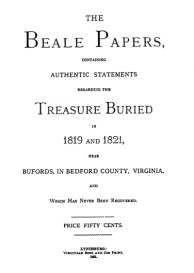
Crack the Beale Papers and find a $65 Million buried treasure? The story of a priceless buried treasure of gold, silver and jewels (worth around $65 million in today's money) began in January 1822. A stranger by the name of Thomas Beale walked into the Washington Hotel Virginia with a locked iron box, which he gave... Continue Reading →

Volume optimization of a cuboid

Volume optimization of a cuboid This is an extension of the Nrich task which is currently live - where students have to find the maximum volume of a cuboid formed by cutting squares of size x from each corner of a 20 x 20 piece of paper.  I'm going to use an n x 10 rectangle... Continue Reading →

Projective Geometry

Projective Geometry Geometry is a discipline which has long been subject to mathematical fashions of the ages. In classical Greece, Euclid’s elements (Euclid pictured above) with their logical axiomatic base established the subject as the pinnacle on the “great mountain of Truth” that all other disciplines could but hope to scale. However the status of... Continue Reading →

Modeling hours of daylight

Modeling hours of daylight Desmos has a nice student activity (on teacher.desmos.com) modeling the number of hours of daylight in Florida versus Alaska - which both produce a nice sine curve when plotted on a graph.  So let's see if this relationship also holds between Phuket and Manchester. First we can find the daylight hours... Continue Reading →

How to avoid a troll – a puzzle

This is a nice example of using some maths to solve a puzzle from the mindyourdecisions youtube channel (screencaptures from the video). How to Avoid The Troll: A Puzzle In these situations it's best to look at the extreme case first so you get some idea of the problem.  If you are feeling particularly pessimistic... Continue Reading →

Non Euclidean Geometry – An Introduction

Non Euclidean Geometry - An Introduction It wouldn't be an exaggeration to describe the development of non-Euclidean geometry in the 19th Century as one of the most profound mathematical achievements of the last 2000 years.  Ever since Euclid (c. 330-275BC) included in his geometrical proofs an assumption (postulate) about parallel lines, mathematicians had been trying... Continue Reading →

The Telephone Numbers – Graph Theory

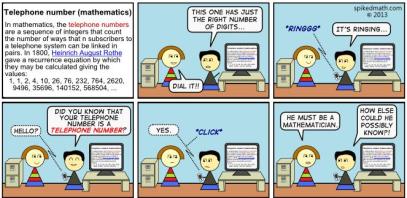
The Telephone Numbers - Graph Theory The telephone numbers are the following sequence: 1, 1, 2, 4, 10, 26, 76, 232, 764, 2620, 9496... (where we start from n=0). This pattern describes the total number of ways which a telephone exchange with n telephones can place a connection between pairs of people. To illustrate this... Continue Reading →

Modelling more Chaos

Modelling more Chaos This post was inspired by Rachel Thomas' Nrich article on the same topic.  I'll carry on the investigation suggested in the article.  We're going to explore chaotic behavior - where small changes to initial conditions lead to widely different outcomes.  Chaotic behavior is what makes modelling (say) weather patterns so complex. f(x)... Continue Reading →

Farey Sequences

This is a mini investigation based on the current Nrich task Farey Sequences. As Nrich explains: I'm going to look at Farey sequences (though I won't worry about rearranging them in order of size).  Here are some of the first Farey sequences.  The missing fractions are all ones which simplify to a fraction already on... Continue Reading →

Modelling Chaos

Modelling Chaos This post was inspired by Rachel Thomas' Nrich article on the same topic.  I'll carry on the investigation suggested in the article.  We're going to explore chaotic behavior - where small changes to initial conditions lead to widely different outcomes.  Chaotic behavior is what makes modelling (say) weather patterns so complex. Let's start... Continue Reading →

The Folium of Descartes

The Folium of Descartes The folium of Descartes is a famous curve named after the French philosopher and mathematician Rene Descartes (pictured top right).  As well as significant contributions to philosophy ("I think therefore I am") he was also the father of modern geometry through the development of the x,y coordinate system of plotting algebraic... Continue Reading →

Spotting Asset Bubbles

Spotting Asset Bubbles Asset bubbles are formed when a service, product or company becomes massively over-valued only to crash, taking with it most of its investors' money.  There are many examples of asset bubbles in history - the Dutch tulip bulb mania and the South Sea bubble are two of the most famous historical examples.... Continue Reading →

The Remarkable Dirac Delta Function

The Remarkable Dirac Delta Function This is a brief introduction to the Dirac Delta function - named after the legendary Nobel prize winning physicist Paul Dirac. Dirac was one of the founding fathers of the mathematics of quantum mechanics, and is widely regarded as one of the most influential physicists of the 20th Century.  This... Continue Reading →

The Rise of Bitcoin

The Rise of Bitcoin Bitcoin is in the news again as it hits $10,000 a coin - the online crypto-currency has seen huge growth over the past 1 1/2 years, and there are now reports that hedge funds are now investing part of their portfolios in the currency.   So let's have a look at... Continue Reading →

Fun with Functions!

This post is inspired by the Quora thread on interesting functions to plot. The butterfly This is a slightly simpler version of the butterfly curve which is plotted using polar coordinates on Desmos as: Polar coordinates are an alternative way of plotting functions - and are explored a little in HL Maths when looking at... Continue Reading →

Euler’s 9 Point Circle

Euler's 9 Point Circle This is a nice introduction to some of the beautiful constructions of geometry.  This branch of mathematics goes in and out of favour - back in the days of Euclid, constructions using lines and circles were a cornerstone of mathematical proof, interest was later revived in the 1800s through Poncelot's projective... Continue Reading →

Log Graphs to Plot Planetary Patterns

Log Graphs to Plot Planetary Patterns This post is inspired by the excellent Professor Stewart's latest book, Calculating the Cosmos. In it he looks at some of the mathematics behind our astronomical knowledge. Astronomical investigations In the late 1760s and early 1770s, 2 astronomers Titius and Bode both noticed something quite strange - there seemed... Continue Reading →

Modeling with springs and weights

This is a quick example of how using Tracker software can generate a nice physics-related exploration.  I took a spring, and attached it to a stand with a weight hanging from the end.  I then took a video of the movement of the spring, and then uploaded this to Tracker. Height against time The first... Continue Reading →

Optimization of area – an investigation

This is an example of how an investigation into area optimisation could progress.  The problem is this: A farmer has 40m of fencing.  What is the maximum area he can enclose? Case 1:  The rectangle: Reflection - the rectangle turns out to be a square, with sides 10m by 10m.  Therefore the area enclosed is... Continue Reading →

Cracking ISBN and Credit Card Codes

Cracking ISBN and Credit Card Codes ISBN codes are used on all books published worldwide. It’s a very powerful and useful code, because it has been designed so that if you enter the wrong ISBN code the computer will immediately know – so that you don’t end up with the wrong book. There is lots... Continue Reading →

Modelling a Nuclear War

Modelling a Nuclear War  With the current saber rattling from Donald Trump in the Korean peninsula and the instability of North Korea under Kim Jong Un (incidentally a former IB student!) the threat of nuclear war is once again in the headlines.  Post Cold War we've got somewhat used to the peace afforded by the... Continue Reading →

IGCSE Past Paper Revision Videos

I've just put together a couple of playlists to help students studying for their IGCSE Cambridge 0580 or Cambridge 0607 Maths exams, and also their Additional Mathematics Cambridge 0606 exams. IGCSE Maths Cambridge Playlist: https://www.youtube.com/watch?v=YwTgJrE0UiY&list=PLTzMaA6R8ce0vUIWWwP_-8_tmVK4q0SeR Videos included are: 1. Number 2. Circle Theorems and angles 3. Algebra 4. Volume 5. Statistics 6. Solving equations using... Continue Reading →

NASA, Aliens and Codes in the Sky

NASA, Aliens and Binary Codes from the Star The Drake Equation was intended by astronomer Frank Drake to spark a dialogue about the odds of intelligent life on other planets. He was one of the founding members of SETI - the Search for Extra Terrestrial Intelligence - which has spent the past 50 years scanning... Continue Reading →

Sequence Investigation

Sequence Investigation This is a nice investigation idea from Nrich.  The above screen capture is from their Picture Story puzzle.  We have successive cubes - a 1x1x1 cube, a 2x2x2 cube etc. The cubes are then rearranged to give the following shape.  The puzzle is then to use this information to discover a mathematical relationship.... Continue Reading →

IB Standard Level Revision Videos

IB Standard Level Revision Videos With the IB SL Maths exams fast approaching here are some video resources to help with revision: Algebra, Functions, Trigonometry past paper questions This is a playlist with past paper questions covering: 1) Algebra:arithmetic and geometric sequences and series, logs, binomial expansion, 2) functions: Inverses, completing the square, sketching quadratics... Continue Reading →

Simulating Traffic Jams and Asteroids

Simulations -Traffic Jams and Asteroid Impacts Why do traffic jams form?  How does the speed limit or traffic lights or the number of lorries on the road affect road conditions?   You can run a number of different simulations - looking at ring road traffic, lane closures and how robust the system is by applying an... Continue Reading →

Even Pigeons Can Do Maths

Even Pigeons Can Do Maths This is a really interesting study from a couple of years ago, which shows that even pigeons can deal with numbers as abstract quantities - in the study the pigeons counted groups of objects in their head and then classified the groups in terms of size. From the New York... Continue Reading →

Make 2017 – A Puzzle

This is a great puzzle which the Guardian ran last week: Fill in the equations below using any of the basic mathematical operations, +, –, x, ÷, and as many brackets as you like, so that they make arithmetical sense. 10 9 8 7 6 5 4 3 2 1 = 2017 There are many... Continue Reading →

Finger Ratio Predicts Maths Ability?

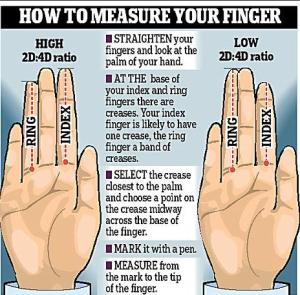
Finger Ratio Predicts Maths Ability? Some of the studies on the 2D: 4D finger ratios (as measured in the picture above) are interesting when considering what factors possibly affect mathematical ability.  A 2007 study by Mark Brosnan from the University of Bath found that: "Boys with the longest ring fingers relative to their index fingers... Continue Reading →

Modelling Radioactive Decay

Modelling Radioactive decay We can model radioactive decay of atoms using the following equation: N(t) = N0 e-λt Where: N0: is the initial quantity of the element λ: is the radioactive decay constant t: is time N(t): is the quantity of the element remaining after time t. So, for Carbon-14 which has a half life of... Continue Reading →

Amanda Knox and Bad Maths in Courts

Amanda Knox and Bad Maths in Courts This post is inspired by the recent BBC News article, "Amanda Knox and Bad Maths in Courts."   The article highlights the importance of good mathematical understanding when handling probabilities - and how mistakes by judges and juries can sometimes lead to miscarriages of justice. A scenario to give to... Continue Reading →

Powered by WordPress.com.

Up ↑