The Battle over Homework: Marking in Mathematics Within five minutes of any teaching inspection from OFSTED, the inspector will be leafing through students’ exercise books in search of evidence of regular and meaningful marking. If it’s not there then they will probably already be penciling in the “requires improvement” column. With no-notice inspections now in... Continue Reading →
Mathematical Proof and Paradox
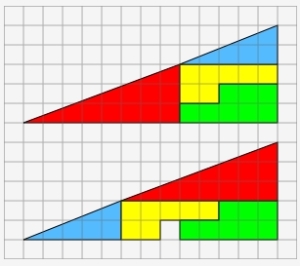
https://www.youtube.com/watch?v=t8XMeocLflc This classic clip "proves" how 25/5 = 14, and does it three different ways. Maths is a powerful method for providing proof - but we need to be careful that each step is based on correct assumptions. One of the most well known fake proofs is as follows: let a = b Then a2... Continue Reading →
Game Theory and Tic Tac Toe
Game Theory and Tic Tac Toe The game of Noughts and Crosses or Tic Tac Toe is well known throughout the world and variants are thought to have been played over 2000 years ago in Rome. It's a very simple game - the first person to get 3 in a row wins. In fact it's... Continue Reading →
Maths and Chess
Maths and Chess Magnus Carlsen, the 22 year old chess prodigy from Norway (pictured above), has just been crowned World Chess Champion, winning £1.4 million in the process. He beat the Indian Grandmaster Vishy Anand in a 12 match series in India with 2 games to go. Anand has been the World Champion since 2007... Continue Reading →
Knight’s Tour
The Knight's Tour is a mathematical puzzle that has endured over 1000 years. The question is simple enough - a knight (which can move as illustrated above) wants to visit all the squares on a chess board only once. What paths can it take? You can vary the problem by requiring that the knight starts... Continue Reading →
The Birthday Problem
http://www.youtube.com/watch?v=a2ey9a70yY0 The Birthday Problem One version of the birthday problem is as follows: How many people need to be in a room such that there is a greater than 50% chance that 2 people share the same birthday. This is an interesting question as it shows that probabilities are often counter-intuitive. The answer is that... Continue Reading →
War Maths – Projectile Motion
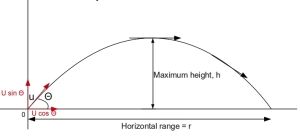
War Maths - Projectile Motion Despite maths having a reputation for being a somewhat bookish subject, it is also an integral part of the seamier side of human nature and has been used by armies to give their side an advantage in wars throughout the ages. Military officers all need to have a firm grasp... Continue Reading →
The Goldbach Conjecture
The Goldbach Conjecture is one of the most famous problems in mathematics. It has remained unsolved for over 250 years - after being proposed by German mathematician Christian Goldbach in 1742. Anyone who could provide a proof would certainly go down in history as one of the true great mathematicians. The conjecture itself is deceptively... Continue Reading →
The Gambler’s Fallacy and Casino Maths
http://www.youtube.com/watch?v=K8SkCh-n4rw The Gambler's Fallacy The above video is an excellent introduction to the gambler's fallacy. This is the misconception that prior outcomes will have an effect on subsequent independent events. The classic example for this is the gambler who watches a run of 9 blacks on a roulette wheel with only red and black, and... Continue Reading →
Maths and Music
Western music has its roots in the harmonics discovered by Pythagoras - himself a keen musician - over 2000 years ago. Pythagoras noticed that certain string ratios would produce sounds that were in harmony with each other. The simplest example is illustrated above with an electric guitar. When a string is played, and then that... Continue Reading →
School Code Challenge!
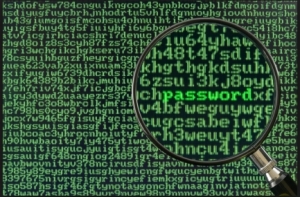
The School Code Challenge is based on a similar competition that GCHQ (The UK digital spy agency) are running. My clues will however be a little more accessible! I have created a number of codes that need to be broken. Each code will give a password. When you crack the code, follow the link and... Continue Reading →
Hexaflexagons – Amazing Shapes Investigation
http://www.youtube.com/watch?v=VIVIegSt81k Hexaflexagons - Amazing Shapes Investigation: Hexaflexagons look at first glance to be somewhat prosaic origami shapes - but like mobius strips they hide some surprises. Flexagons are paper shapes that can be folded to reveal hidden faces - and hexaflexagons themselves have six sides. What's remarkable about hexaflexagons is that during folding, some faces... Continue Reading →
RSA Public Key Encryption – The Code that Secures the internet
Cracking RSA Code - The World's Most Important Code? RSA code is the basis of all important data transfer. Encrypted data that needs to be sent between two parties, such as banking data or secure communications relies on the techniques of RSA code. RSA code was invented in 1978 by three mathematicians (Rivest, Shamir and... Continue Reading →

Crack the Code to Become a Spy
GCHQ - the British cyber spy agency - have had a rough few months following some staggering revelations from Edward Snowden, so they're doing some positive PR at the moment to highlight the importance of mathematics and computing skills in code-breaking. There are 4 codes to solve (the first one posted above) - each answer... Continue Reading →
Maths IA – Exploration Topics
Maths IA – 300 Maths Exploration Topics: Scroll down this page to find over 300 examples of maths IA exploration topics and ideas for IB mathematics students doing their internal assessment (IA) coursework. Topics include Algebra and Number (proof), Geometry, Calculus, Statistics and Probability, Physics, and links with other subjects. Suitable for Applications and Interpretations... Continue Reading →
Become a Maths Calendar Savant!
http://www.youtube.com/watch?v=CegSgiWNgAI Giving students an insight into mathematical savants and other mathematical geniuses is a good way of invoking a sense of wonder about the subject. Calendar savants are able to correctly name the day of the week from any given date in history - almost instantly. Whilst it is still not clear how they do... Continue Reading →
Maths Magic
https://www.youtube.com/watch?v=M4vqr3_ROIk The video above is a great example of "mathemagic" - magic through maths. Arthur Benjamin's show at TED (using a mixture of mathematical tricks and savant like numerical ability) shows how numerical calculations can still produce a sense of awe and wonder. Probably the best resource for "mathemagic" is the TES Word ebook from... Continue Reading →
The Gorilla in the Room and Other Great Maths Investigations
http://www.youtube.com/watch?v=G-lN8vWm3m0 The Gorilla in the Room and Other Great Maths Investigations These topics are a great way to add interest to statistics and probability lessons at KS3 and KS4 level, and also a good example of investigations that IB students can conduct. They also have a nice link to ToK - how can we believe... Continue Reading →
Are You Living in a Computer Simulation?
Are You Living in a Computer Simulation? This idea might be familiar to fans of The Matrix - and at first glance may seem somewhat unbelievable. However, Oxford University Professor Nick Bostrom makes an interesting case using both conditional probability and logic as to why it's more likely than you might think. The summary of... Continue Reading →
Utility Value – How Maths Can Make You Happier
Utility Value - How Maths Can Make You Happier The use of utility curves to make optimal decisions is something which is never really touched on in mathematics - even though they are a powerful tool for making good choices in life. "Utility" is used to represent personal benefit - and in this graph, maximum... Continue Reading →
Bridge Building Lesson Plan
Bridge Building Lesson Plan Learning Objectives: Students are introduced to one of the many careers that they can pursue through mathematics. 5 minutes: Brainstorm – why is mathematics useful for engineering? What kinds of jobs do engineers do? (refer to maths careers site – a large number of well paid jobs are in engineering) 5... Continue Reading →
Black Swans and Civilisation Collapse
Black Swans and Civilisation Collapse A really interesting branch of mathematics is involved in making future predictions about how civilisation will evolve in the future - and indeed looking at how robust our civilisation is to external shocks. This is one area in which mathematical models do not have a good record as it is... Continue Reading →
The Riemann Hypothesis Explained
The Riemann Hypothesis Explained This is quite a complex topic probably only accessible for high achieving HL IB students, but nevertheless it's still a fascinating introduction to one of the most important (and valuable) unsolved problems in pure mathematics. Firstly, the Riemann Hypothesis is concerned with the Riemann zeta function. This function is defined in... Continue Reading →
Sierpinski Triangles and Spirolateral Investigation Lesson Plan
Sierpinski Triangles and Spirolateral Investigation Lesson Plan Leaning Objective: Students are introduced to some more complex ideas in mathematics (fractals, infinite perimeter, fractional dimensions), students explore the relationship between maths and art, students conduct an open ended invesigation into patterns and sequences. 10 minutes Start the lesson with the Mandelbrot Zoom in the background: http://www.youtube.com/watch?v=0jGaio87u3A Discussion about what... Continue Reading →
How Are Prime Numbers Distributed? Twin Primes Conjecture
How Are Prime Numbers Distributed? Twin Primes Conjecture Thanks to a great post on the Teaching Mathematics blog about getting students to conduct an open ended investigation on consecutive numbers, I tried this with my year 10s - with some really interesting results. My favourites were these conjectures: 1) In a set of any 10... Continue Reading →
Synesthesia – Do Your Numbers Have Colour?
Synesthesia - Do Your Numbers Have Colour? Synesthesia is another topic which provides insights into how people perceive numbers - and how a synesthetic's perception of the mathematical world is distinctly different to everyone else's. Those with synesthesia have a cross-wiring of brain activity between 2 of their senses - so for example they may... Continue Reading →
Imagining the 4th Dimension
Imagining the 4th Dimension Imagining extra dimensions is a fantastic ToK topic - it is something which seems counter-intuitively false, something which we have no empirical evidence to support, and yet it is something which seems to fit the latest mathematical models on string theory (which requires 11 dimensions). Mathematical models have consistently been shown... Continue Reading →
e’s are good – He’s Leonard Euler.
e's are good - He's Leonard Euler. Having recently starting a topic on the exponential function, I was really struggling to find some good resources online - which is pretty surprising given that e is one of the most important and useful numbers in mathematics. So, here are some possible approaches. 1) e memorisation challenge. This... Continue Reading →
The Mathematics of Cons – Pyramid Selling
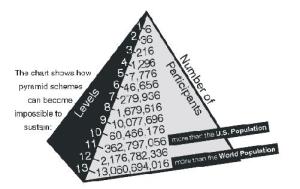
The Mathematics of Cons - Pyramid Selling Pyramid schemes are a very old con - but whilst illegal, still exist in various forms. Understanding the maths behind them therefore is a good way to avoid losing your savings! The most basic version of the fraud starts with an individual making the following proposition, "pay me... Continue Reading →
A Maths Snooker Puzzle
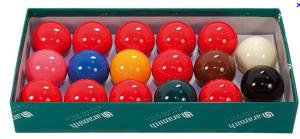
A Maths Snooker Puzzle This was suggested by Paul our Physics teacher - and is a nice little maths puzzle. The maximum break score in snooker is 147 which is achieved by: 15 reds (1 point each) , 15 blacks (7 points each), then yellow ( 2 points), then green (3 points), brown (4 points), blue... Continue Reading →
Maths Invented or Discovered?
Maths Invented or Discovered? The PBS Ideas Channel has just released a new video which discusses whether maths is invented by humans, or whether it is discovered (ie whether it can be said to really exist). It's an excellent 10 minute introduction to a pretty complicated topic - and certainly accessible for students: http://www.youtube.com/watch?v=TbNymweHW4E For... Continue Reading →
Which Times Tables do Students Find Difficult? An Investigation.
Which Times Tables do Students Find Difficult? There's an excellent article on today's Guardian Datablog looking at a computer based study (with 232 primary school students) on which times tables students find easiest and difficult. Edited highlights (Guardian quotes in italics): Which multiplication did students get wrong most often? The hardest multiplication was six times... Continue Reading →
Cracking Codes Lesson
Cracking Codes Lesson 1 Introduction: 5 minutes - Use a Morse Code Generator to play some (very slowed down) messages for students to decode. Discuss why this is was a good way to transmit data in the past. Brainstorm: 5 minutes – Why are codes important? Who uses them? Why do mathematicians go into this career? ... Continue Reading →
Wau: The Most Amazing Number in the World?
Wau: The Most Amazing Number in the World? This is a fantastic video from Vi Hart of Khan Academy. Watch it first and marvel at the properties of this amazing number: https://www.youtube.com/watch?feature=player_embedded&v=GFLkou8NvJo Once you have watched it, watch it again - this time thinking about what number Wau might be - and why you have... Continue Reading →
Cracking ISBN and Credit Card Codes
Cracking ISBN and Credit Card Codes ISBN codes are used on all books published worldwide. It’s a very powerful and useful code, because it has been designed so that if you enter the wrong ISBN code the computer will immediately know – so that you don’t end up with the wrong book. There is lots... Continue Reading →
NASA, Aliens and Binary Codes from the Stars
NASA, Aliens and Binary Codes from the Star The Drake Equation was intended by astronomer Frank Drake to spark a dialogue about the odds of intelligent life on other planets. He was one of the founding members of SETI - the Search for Extra Terrestrial Intelligence - which has spent the past 50 years scanning... Continue Reading →
Benford’s Law – Using Maths to Catch Fraudsters
http://www.youtube.com/watch?v=vIsDjbhbADY Benford's Law - Using Maths to Catch Fraudsters Benford's Law is a very powerful and counter-intuitive mathematical rule which determines the distribution of leading digits (ie the first digit in any number). You would probably expect that distribution would be equal - that a number 9 occurs as often as a number 1. But... Continue Reading →
Simulations -Traffic Jams and Asteroid Impacts
Simulations -Traffic Jams and Asteroid Impacts You can study the mathematics behind traffic flow using this simulator. Why do traffic jams form? How does the speed limit or traffic lights or the number of lorries on the road affect road conditions? You can run a number of different simulations - looking at ring road traffic,... Continue Reading →
Time Travel and the Speed of Light
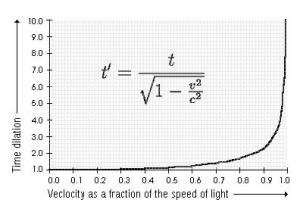
Time Travel and the Speed of Light This is one of my favourite videos from the legendary Carl Sagan. He explains the consequences of near to speed of light travel. https://www.youtube.com/watch?v=lPoGVP-wZv8 This topic fits quite well into a number of mathematical topics - from graphing, to real life uses of equations, to standard form and... Continue Reading →
Even Pigeons Can Do Maths
Even Pigeons Can Do Maths This is a really interesting study from a couple of years ago, which shows that even pigeons can deal with numbers as abstract quantities - in the study the pigeons counted groups of objects in their head and then classified the groups in terms of size. From the New York... Continue Reading →
One Direction Maths Song
A maths song sung by current flavour of the month One Direction - follow the lyrics to arrive at the total. http://www.youtube.com/watch?v=gIpdV9jSpXU Some of the best maths songs are by Learning Upgrade, such as, videos on circle formulae, fractions, exponents, the quadratic formula and the one below, "Mean, Median and Mode": http://www.youtube.com/watch?v=uydzT_WiRz4 Some other good maths songs:... Continue Reading →
Finger Ratio Predicts Maths Ability?
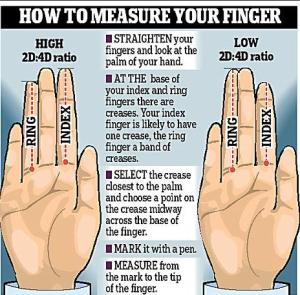
Finger Ratio Predicts Maths Ability? Some of the studies on the 2D: 4D finger ratios (as measured in the picture above) are interesting when considering what factors possibly affect mathematical ability. A 2007 study by Mark Brosnan from the University of Bath found that: "Boys with the longest ring fingers relative to their index fingers... Continue Reading →
Amanda Knox and Bad Maths in Courts
Amanda Knox and Bad Maths in Courts This post is inspired by the recent BBC News article, "Amanda Knox and Bad Maths in Courts." The article highlights the importance of good mathematical understanding when handling probabilities - and how mistakes by judges and juries can sometimes lead to miscarriages of justice. A scenario to give to... Continue Reading →
Does it Pay to be Nice? Game Theory and Evolution
Does it Pay to be Nice? Game Theory and Evolution Game theory is an interesting branch of mathematics with links across a large number of disciplines - from politics to economics to biology and psychology. The most well known example is that of the Prisoner's Dilemma. (Illustrated below). Two prisoners are taken into custody and... Continue Reading →
Is God a Mathematician?
Is God a Mathematician? http://www.youtube.com/watch?v=jremlZvNDuk&feature=youtu.be That's the provocative question posed by American Physicist Michio Kaku in this fascinating 5 minute interview which takes in the ideas of Newton, Einstein and modern ideas on String Theory. It addresses the fundamental questions in maths ToK - is mathematics invented or discovered? What explains the "unreasonable effectiveness" of... Continue Reading →
Premier League Finances – Debt and Wages
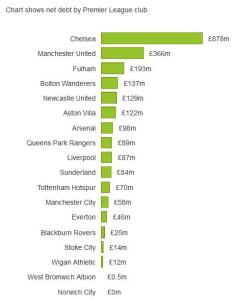
Premier League Finances - Debt and Wages This is a great article from the Guardian DataBlog analysing the finances for last season's Premier League clubs. As the Guardian says, "More than two thirds of the Premier League's record £2.4bn income in 2011-12 was paid out in wages, according to the most recently published accounts of... Continue Reading →
Why Study Maths? Careers Inspiration
This is inspired by a fantastic website - we use math - which has a massive amount of information about different careers using mathematics in a really well laid out format. According to a comprehensive careers survey by Careers Cast - which looked at over 200 different jobs and ranked them for stress, pay, job... Continue Reading →
Michio Kaku – Universe in a Nutshell
Michio Kaku - American Professor of Theoretical Physics and fantastic populariser of mathematics and physics takes us through a 40 minute journey on the importance of physics in explaining the universe: http://www.youtube.com/watch?v=0NbBjNiw4tk Great stuff - well worth watching!
Graham’s Number – literally big enough to collapse your head into a black hole
Graham's Number - literally big enough to collapse your head into a black hole Graham's Number is a number so big that it would literally collapse your head into a black hole were you fully able to comprehend it. And that's not hyperbole - the informational content of Graham's Number is so astronomically large that... Continue Reading →
Maths Podcasts
Plus Maths has a large number of great podcasts which look at maths ToK topics: 1) An interview with Max Tegmark (pictured above) about why he thinks that the universe is itself a mathematical structure. 2) An interview with physicists David Berman about how many dimensions exist. 3) A talk with cosmologist John Barrow about... Continue Reading →