Proving Pythagoras Like Einstein?

Proving Pythagoras Like Einstein? There are many ways to prove Pythagoras' theorem - Einstein reputedly used the sketch above to prove this using similar triangles.  To keep in the spirit of discovery I also just took this diagram as a starting point and tried to prove this myself, (though Einstein's version turns out to be... Continue Reading →

The Mordell Equation

The Mordell Equation [Fermat's proof] Let's have a look at a special case of the Mordell Equation, which looks at the difference between an integer cube and an integer square.  In this case we want to find all the integers x,y such that the difference between the cube and the square gives 2.  These sorts... Continue Reading →

Hollow Cubes and Hypercubes investigation

Hollow Cubes investigation Hollow cubes like the picture above [reference] are an extension of the hollow squares investigation done previously.  This time we can imagine a 3 dimensional stack of soldiers, and so try to work out which numbers of soldiers can be arranged into hollow cubes. Therefore what we need to find is what... Continue Reading →

Waging war with maths: Hollow squares

Waging war with maths: Hollow squares The picture above [US National Archives, Wikipedia] shows an example of the hollow square infantry formation which was used in wars over several hundred years.  The idea was to have an outer square of men, with an inner empty square.  This then allowed the men in the formation to... Continue Reading →

Volume optimization of a cuboid

Volume optimization of a cuboid This is an extension of the Nrich task which is currently live - where students have to find the maximum volume of a cuboid formed by cutting squares of size x from each corner of a 20 x 20 piece of paper.  I'm going to use an n x 10 rectangle... Continue Reading →

How to avoid a troll – a puzzle

This is a nice example of using some maths to solve a puzzle from the mindyourdecisions youtube channel (screencaptures from the video). How to Avoid The Troll: A Puzzle In these situations it's best to look at the extreme case first so you get some idea of the problem.  If you are feeling particularly pessimistic... Continue Reading →

Optimization of area – an investigation

This is an example of how an investigation into area optimisation could progress.  The problem is this: A farmer has 40m of fencing.  What is the maximum area he can enclose? Case 1:  The rectangle: Reflection - the rectangle turns out to be a square, with sides 10m by 10m.  Therefore the area enclosed is... Continue Reading →

Sequence Investigation

Sequence Investigation This is a nice investigation idea from Nrich.  The above screen capture is from their Picture Story puzzle.  We have successive cubes - a 1x1x1 cube, a 2x2x2 cube etc. The cubes are then rearranged to give the following shape.  The puzzle is then to use this information to discover a mathematical relationship.... Continue Reading →

Make 2017 – A Puzzle

This is a great puzzle which the Guardian ran last week: Fill in the equations below using any of the basic mathematical operations, +, –, x, ÷, and as many brackets as you like, so that they make arithmetical sense. 10 9 8 7 6 5 4 3 2 1 = 2017 There are many... Continue Reading →

How to Avoid The Troll: A Puzzle

This is a nice example of using some maths to solve a puzzle from the mindyourdecisions youtube channel (screencaptures from the video). How to Avoid The Troll: A Puzzle In these situations it's best to look at the extreme case first so you get some idea of the problem.  If you are feeling particularly pessimistic... Continue Reading →

Arithmetic Sequences Puzzle

Can you find a sequence of consecutive integers that add up to 1000? This puzzle is based on the excellent book A First Step to Mathematical Olympiad Problems - which is full of problems that could be extended to become exploration ideas. Step 1 - arithmetic formula Our first step is to write out what... Continue Reading →

Hailstone Numbers

Hailstone Numbers This is a post inspired by the article on the same topic by the ever brilliant Plus Maths. Hailstone numbers are created by the following rules: if n is even: divide by 2 if n is odd: times by 3 and add 1 We can then generate a sequence from any starting number. ... Continue Reading →

Stellar Numbers Investigation

Stellar Numbers Investigation This is an old IB internal assessment question and so can not be used for the new IB exploration - however it does give a good example of the sort of pattern investigation that is possible. The task starts off with the fairly straightforward problem of trying to find the nth term... Continue Reading →

Maths Puzzles

Maths Puzzles These should all be accessible for top sets in KS4 and post 16.  See if you can manage to get all 3 correct. Puzzle Number 1 Why is xx undefined when x = 0 ? Puzzle Number 2 I multiply 3 consecutive integers together. My answer is 8 times the middle of the... Continue Reading →

Murder in the Maths Department

Murder in the Maths Department A murder has been committed in the maths department! A body has been discovered surrounded by mathematical objects and only the hardworking maths teachers were in school, doing long division sums for fun at the weekend. One of them must be the murderer.  (The wall of fame of successful detectives... Continue Reading →

The Telephone Numbers – Graph Theory

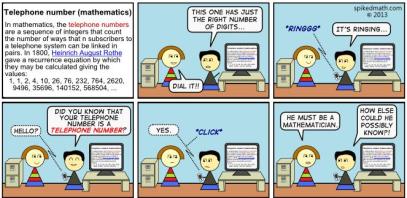
The Telephone Numbers - Graph Theory The telephone numbers are the following sequence: 1, 1, 2, 4, 10, 26, 76, 232, 764, 2620, 9496... (where we start from n=0). This pattern describes the total number of ways which a telephone exchange with n telephones can place a connection between pairs of people. To illustrate this... Continue Reading →

Using Chi Squared to Crack Codes

This is inspired from the great site,  Practical Cryptography which is a really good resource for code making and code breaking.  One of their articles is about how we can use the Chi Squared test to crack a Caesar Shift code.  Indeed, if you use an online program to crack a Caesar shift, they are... Continue Reading →

Code Breakers Wanted by the NSA

  Code Breakers Wanted by the NSA The American National Security Agency have just launched a new code breaking challenge.  The tweet above is the first in their series for those interested in a career in code breaking.  The NSA are possibly in search of some good publicity after the revelations of Edward Snowden with... Continue Reading →

Visualising Algebra Through Geometry

Visualising Algebra Through Geometry This picture above is a fantastic example of how we can use geometry to visualise an algebraic expression.  It's taken from Brilliant - which is a fantastic new forum for sharing maths puzzles.  This particular puzzle was created and uploaded by Arron Kau.  The question is, which of the following mathematical... Continue Reading →

Investigation into the Amazing e

e's are good - He's Leonard Euler. Along with pi, e is one of the most important constants in mathematics. It is an irrational number which carries on forever. The first few digits are 2.718281828459045235... Leonard Euler e is sometime named after Leonard Euler (Euler’s number).   He wasn't the first mathematician to discover e -... Continue Reading →

Maths and Chess

Maths and Chess Magnus Carlsen, the 22 year old chess prodigy from Norway (pictured above), has just been crowned World Chess Champion, winning £1.4 million in the process.  He beat the Indian Grandmaster Vishy Anand in a 12 match series in India with 2 games to go.  Anand has been the World Champion since 2007... Continue Reading →

Knight’s Tour

The Knight's Tour is a mathematical puzzle that has endured over 1000 years.  The question is simple enough - a knight (which can move as illustrated above) wants to visit all the squares on a chess board only once.  What paths can it take?  You can vary the problem by requiring that the knight starts... Continue Reading →

The Goldbach Conjecture

The Goldbach Conjecture is one of the most famous problems in mathematics.  It has remained unsolved for over 250 years - after being proposed by German mathematician Christian Goldbach in 1742.  Anyone who could provide a proof would certainly go down in history as one of the true great mathematicians.  The conjecture itself is deceptively... Continue Reading →

Crack the Code to Become a Spy

GCHQ - the British cyber spy agency - have had a rough few months following some staggering revelations from Edward Snowden, so they're doing some positive PR at the moment to highlight the importance of mathematics and computing skills in code-breaking.  There are 4 codes to solve (the first one posted above) - each answer... Continue Reading →

A Maths Snooker Puzzle

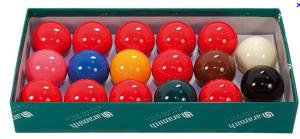
A Maths Snooker Puzzle This was suggested by Paul our Physics teacher - and is a nice little maths puzzle. The maximum break score in snooker is 147 which is achieved by: 15 reds (1 point each) , 15 blacks (7 points each), then yellow ( 2 points), then green (3 points), brown (4 points), blue... Continue Reading →

Cracking Codes Lesson

Cracking Codes Lesson 1 Introduction: 5 minutes - Use a Morse Code Generator to play some (very slowed down) messages for students to decode.  Discuss why this is was a good way to transmit data in the past. Brainstorm: 5 minutes – Why are codes important?  Who uses them?  Why do mathematicians go into this career? ... Continue Reading →

Powered by WordPress.com.

Up ↑